
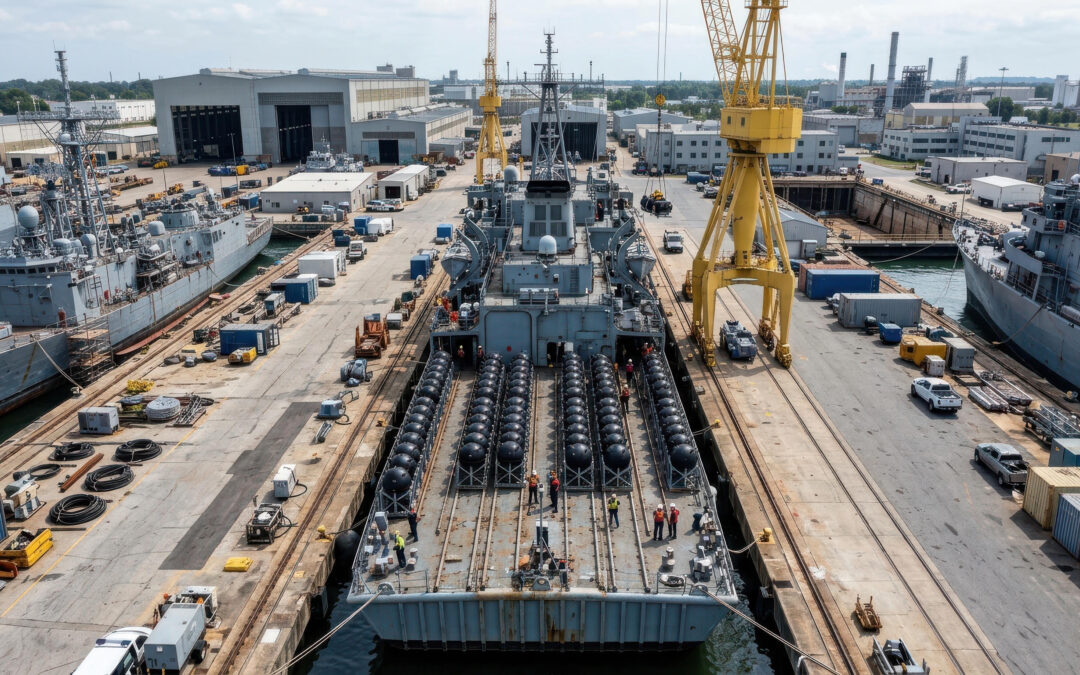
A new crew arrives at a US shipyard ready to work and still spends the morning outside the gate. The missing requirement might be a Maritime OSHA 10 card that nobody mentioned until the badge application went through.
For the civilian subcontractor, that raises a reasonable question: if OSHA calls this training voluntary, why is the shipyard asking for it?
The requirement may come from the contract between the Navy, the government, or the facility’s access policy. Federal OSHA does not generally require workers to complete its Outreach courses, but employers and other organizations can make them a condition of employment or site access. Knowing who imposed the requirement helps you find the right answer before payroll runs on an idle crew.
Does federal OSHA require maritime training?
OSHA’s Outreach Training Program introduces workers to workplace hazards and their rights. The 10-hour course covers basic safety awareness. The 30-hour course allows more time for discussion of applicable Code of Federal Regulations (CFR) and is generally suited to supervisors or workers with safety responsibilities.
Neither card is a professional license. Neither establishes that someone can safely perform every task covered in class. OSHA explains these limits in its Outreach program overview.
For an employer or employee asking, “Is OSHA maritime training required for my assignment?”, the answer depends on the specific work and the rules that apply. That distinction matters when a contractor and its subcontractors repair, maintain, or modernize a military vessel. Someone may remember a classroom discussion about hazardous energy without knowing which equipment feeds the steam line being repaired. The employer still has to provide the instruction required for that work.
Shipyard employment falls under 29 CFR Part 1915; marine terminals and longshoring have their own standards in Parts 1917 and 1918. The relevant requirements depend on the activity. Calling everything near the waterfront “maritime” does not settle which course a customer will accept or which safety standards govern the job.
When comparing maritime training options, start with the work your crew will actually do. Ship repair and cargo handling present different hazards, even when they happen a short walk apart.
Is OSHA maritime training mandatory under your contract?
A NAVSEA (Naval Sea Systems Command) repair purchase order may incorporate safety requirements through attachments, referenced standards, or the prime contractor’s subcontract terms. Those documents deserve attention before you price the work. If a civilian contractor asks, “Is OSHA maritime training mandatory for everyone on this crew?”, check the clause defining which employees must complete it; the short answer is YES.
Look for the required course, the workers covered, the completion deadline, and any rule about how recently training must have occurred. Ask who approves equivalent instruction. If the wording is unclear, get a written answer from the contracting or safety representative.
Navy repair work requires particular care. NAVSEA Standard Item 009-74 requires repair and maintenance employees aboard vessels, dry docks, and piers to complete the 10-hour Shipyard Employment course, number 7615, or a NAVSEA-approved equivalent within 60 days of employment. The version incorporated into your contract controls; an older copy found online cannot establish today’s obligations.
A training deadline also does not automatically grant permission to enter a facility while training is pending. Confirm the badging arrangements separately, especially when a civilian contractor and subcontractors supply new workers after the project begins.
Commercial yards can impose their own conditions. Avoid assuming that every facility operated by a large shipbuilder follows an identical policy. The project documents and the yard’s current instructions are more useful than another contractor’s recollection.
Before choosing an OSHA 10-hour Maritime class, send the proposed course details to whoever approves training records. That exchange can prevent an expensive mistake: paying for instruction the customer won’t accept.
An OSHA construction or general card may leave you short
An experienced welder might already hold an OSHA 10 Construction or General Industry card and reasonably expect it to count. It documents completed training, but it is a different Outreach course. OSHA 10 Construction and General Industry are not transferable to Shipyard Employment due to hazard mismatches. https://www.osha.gov/maritime
If the contract specifies Maritime Shipyard Employment, do not assume a Construction or General Industry card qualifies. Ask about equivalency before mobilizing. Also, avoid telling workers that every shipyard automatically rejects every other card; the organization imposing the requirement decides what it accepts.
The course content should fit the assignment. A shipyard crew may face changing gangway access, adjacent tank hazards, and sparks passing through openings into spaces below. Reading about hot work safety can help workers recognize those concerns, but yard instruction must address actual conditions.
Supervisors may need broader preparation. An OSHA 30-hour Maritime course can support that role when the employer or contract calls for it. Holding a supervisory title alone does not create a universal federal requirement for the card.
What still needs teaching aboard a military ship
Consider a fitter assigned to remove a valve. Before work starts, the employer needs to address the Lockout/Tagout LOTO procedure for hazardous energy release under the applicable NAVSEA standard procedures. A general course cannot identify that vessel’s isolation points or responsibilities, or explain how multiple employers will coordinate their work.
For instance, OSHA’s shipyard lockout/tags-plus standard contains specific program and training requirements. The worker’s instruction must match their responsibilities. General CFRs on maritime electrical hazards provide background, but the employer must establish how the equipment will be made safe.
A tank assignment raises different questions. Under 1915.12, employees entering confined or enclosed spaces need training appropriate to the hazards and their duties. An Outreach card does not authorize entry. Required inspections, atmospheric testing, and protective arrangements must still be in place.
A discussion of confined space dangers is useful preparation for understanding why an apparently empty compartment can be dangerous. It cannot determine whether a particular space is safe that morning.
Any shipboard operations that generate sparks, flames, or heat, known as Hot work, need the same attention to actual conditions. Where fire watches are required, workers need instruction appropriate to their duties. Reviewing fire watch responsibilities clarifies the role; assigning it still requires the employer to follow applicable standards and site procedures.
Keep written training records detailed enough to show what topic was taught, when, and to whom. A spreadsheet containing only “OSHA trained” leaves too much unanswered when the work changes or someone asks for evidence.
Arrange training around the start date
Before paying a safety training provider, confirm that the instructor holds current Maritime Outreach authorization and that the class covers the required industry segment. Request the schedule and ask how completion will be documented.
OSHA limits student contact time to 7.5 hours daily. A 10-hour class therefore needs at least two calendar days, and a 30-hour class needs at least four. Travel, breaks, and administrative time are additional scheduling considerations.
At Illustra Pro, we offer maritime safety training; you can read more about us and our class rules before reserving places. An employee who misses instruction may need to make it up before completing the course. Booking training immediately before mobilization leaves little room for illness or a changed shift.
There can also be a delay between finishing class and receiving the physical card. Ask whether the yard accepts temporary completion documentation. OSHA leaves that acceptance decision to the employer or jobsite. Settle the answer before a worker travels, and keep their OSHA card available to the person processing badges.
Old cards and missing records
OSHA Maritime Outreach student cards do not expire under OSHA’s policy, effective April 1, 2019. Earlier training remains valid as well. A facility may nevertheless require recent training under its own rules.
Check the course date against the project’s requirements instead of relying only on the absence of an expiration date. OSHA’s Outreach FAQs explain the distinction between program policy and requirements imposed by other organizations.
Insurance paperwork deserves a separate check. Longshore Act coverage depends on the worker’s employment and other legal criteria; it does not cover everyone simply because they work near water. Nor should a contractor assume every insurer requires identical Outreach credentials. Review the policy and ask the broker about the proposed work.
The same care belongs in the estimate. If a customer requires additional training, establish who pays for the course and whether paid attendance, travel, or accommodation needs to be included. A low bid can become difficult to deliver when several people need days away from production before they can start.
Subcontracting adds another handoff. The prime contractor may collect records, but a lower-tier employer still needs to understand the requirements. Send the actual training clause with the work package rather than a brief instruction to “provide OSHA cards.” That wording leaves the course type and acceptance criteria unresolved.
For example, a replacement worker might have the correct Maritime course but no accessible copy of the card. Finding that problem during roster review gives the employer time to contact the trainer and ask the yard what evidence it accepts. Finding it at security leaves the supervisor trying to solve a records problem while the rest of the crew waits for instructions outside.
For an upcoming job, the most useful document is a confirmed training requirement tied to a named project. Compare it with each worker’s records, identify any missing instruction, and leave time to resolve questions before dispatch. Use the training calendar once you know which class is accepted. A crew should learn about the shipyard’s card policy while there is still time to act.