
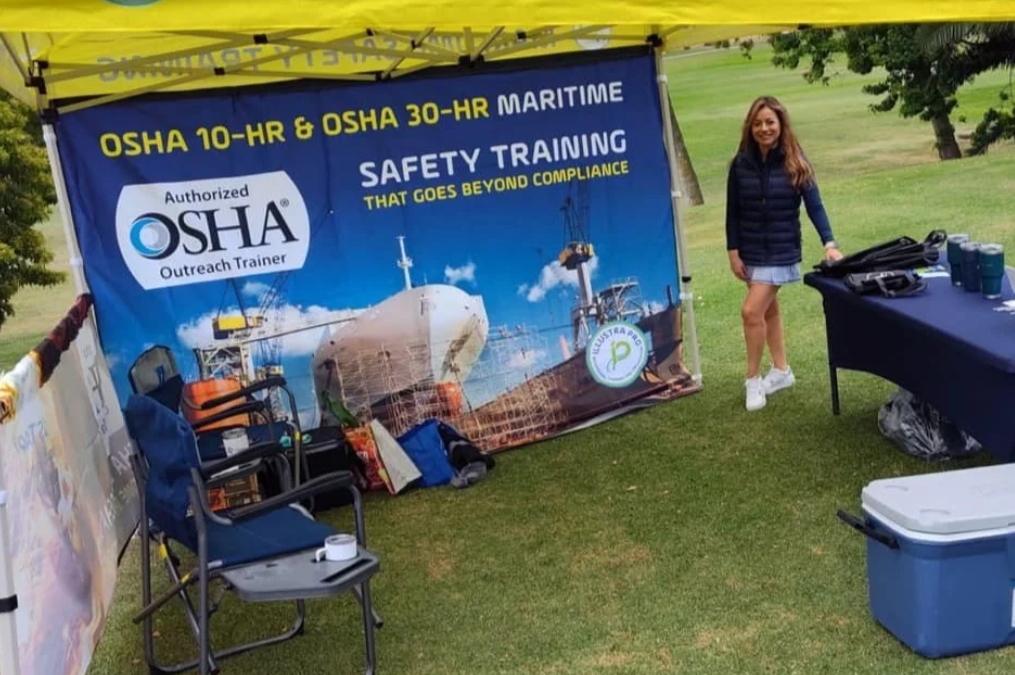
Working at a shipyard or marine terminal involves hazards different from those at a typical construction site. Workers might spend part of a shift welding inside a vessel, handling cargo beside moving equipment, climbing scaffolding, or working near electrical systems in damp conditions. Some jobs also involve confined spaces where workers cannot detect a dangerous atmosphere by sight or smell alone.
That is why employers often ask workers for proof of maritime safety training before allowing them onto a job site. One document they usually request is a completion card for an OSHA 10-Hour or 30-Hour Maritime course.
If you are comparing OSHA maritime certifications, the two cards are related, but they serve different purposes. Your job duties, the employer’s site rules, and the type of work being performed all influence which course makes sense. A card also does not automatically qualify someone to perform every task in a shipyard.
Here is what workers and employers should understand before choosing a course.
What an OSHA Maritime Card Actually Means
The OSHA Maritime Outreach Training Program introduces workers to common workplace hazards, how to recognize and mitigate them, workers’ rights, and employer responsibilities. After successfully completing an authorized course, a participant receives an OSHA Outreach course completion card.
People often call this document an OSHA maritime certification, marine safety card, or OSHA marine card. However, OSHA describes it as a course completion card, not a professional license or certification.
There is also an important distinction between federal requirements and employer requirements. OSHA does not universally require every maritime worker to complete the 10-hour or 30-hour Outreach course. Nevertheless, a shipyard, union, government contractor, or other employer often makes the card a condition of hiring or site access.
That difference matters when choosing training. Before paying for a course, check the requirements of the company or facility where you intend to work. An employer may specify the maritime version, the number of training hours, or an additional qualification beyond the Outreach card.
The official OSHA Outreach Training FAQ explains these distinctions and the limits of the program.
Three OSHA regulations cover different maritime workplaces
Maritime safety is not governed by one rulebook covering every waterfront job. Three sections of Title 29 of the Code of Federal Regulations are especially relevant.
- 29 CFR Part 1915 — Shipyard Employment: Covers shipbuilding, ship repair, shipbreaking, and related work on vessels and in shipyard facilities. It addresses activities such as hot work, fall protection, confined spaces, and hazardous energy.
- 29 CFR Part 1917 — Marine Terminals: Applies to shore-side facilities where cargo moves between vessels and land transportation. It covers cargo-handling equipment, walking and working surfaces, and terminal operations.
- 29 CFR Part 1918 — Longshoring: Addresses cargo-handling work associated with loading and unloading vessels, including activities involving vessel holds and cargo decks.
These distinctions become relevant when an employer selects training for a particular workforce. An employee repairing a ship’s hull and someone handling containers at a terminal may face different daily risks, even if both work around ships.
OSHA maritime Outreach courses address hazards across the maritime sector, but workers should still learn the rules and procedures that apply to their actual jobs.
Choosing an OSHA 10-Hour Maritime Card or OSHA 30-Hour Maritime Card
The main difference is the depth of training and the responsibilities the course is intended to support.
The OSHA 10-Hour Maritime course leads to an OSHA 10-Hour Maritime card and is designed primarily for workers who need a foundation in workplace safety. It is commonly relevant to shipyard laborers, welders, shipfitters, painters, maintenance workers, and other employees who work around maritime hazards.
Topics include personal protective equipment, walking and working surfaces, fall hazards, electrical safety, confined and enclosed spaces, fire protection, and hazardous materials. The course also explains basic worker rights and employer responsibilities.
The OSHA 30-Hour Maritime course leads to an OSHA 30-Hour Maritime card and provides more extensive hazard-awareness training. It is intended mainly for supervisors and workers who have safety responsibilities. Foremen, safety coordinators, project supervisors, and experienced employees moving into leadership positions may find this option more appropriate.
The longer course allows additional time to explore workplace hazards and safety management topics. However, completing it does not automatically qualify someone to act as a safety manager, authorize permits, or perform specialized work. Those responsibilities may require separate training, experience, or employer authorization.
When deciding between the two, start with your position’s requirements rather than assuming the longer OSHA card is always necessary. If your employer specifically requests OSHA 10 Maritime, confirm whether OSHA 30 will be accepted before registering.
How the training is delivered and scheduled
Maritime Outreach classes can be delivered through classroom instruction or approved live virtual instructor-led training. With live virtual training, participants join an instructor remotely, take part in the session, and complete the required coursework. This differs from simply watching recorded videos at a convenient time.
At Illustra Pro, we offer classes through in-person instruction and live virtual training. Our online maritime training page provides more information about remote learning options.
Course length is governed by OSHA Outreach Program requirements. A class may provide no more than 7.5 student contact hours per calendar day under the standard scheduling rules. As a result, a 10-hour course must take at least two calendar days, while a 30-hour course must take at least four.
Contact hours refer to time spent covering course content, not lunch breaks or administrative tasks.
A legitimate course must cover the required topics and instructional hours. Finishing an online registration or receiving a payment confirmation is not the same as completing the training.
Receiving your card, checking its validity, and replacing it
After a student successfully completes the course, the authorized trainer arranges for the Outreach course completion card to be issued. Some providers also supply temporary documentation while the card is being processed. Whether an employer accepts temporary proof is a separate question, so confirm its policy before relying on it for site access.
OSHA requires trainers to issue student course completion cards within 90 days of course completion.
Maritime Outreach cards also have an important feature that workers sometimes misunderstand: cards issued on or after April 1, 2019, do not expire under OSHA Outreach program rules. Earlier maritime cards remain valid under the same guidance, even if they display an expiration date. Employers can still require additional training or refresher sessions under their own policies.
If an OSHA card is lost or damaged, contact the trainer who originally provided the course. OSHA allows a replacement card if the student completed the class within the previous five years, with only one replacement per student per class; only the outreach trainer can issue the card replacement. OSHA does not maintain a national database from which workers can simply order replacement cards themselves.
What the cardholder needs to understand about shipyard hazards
A course completion card introduces important safety concepts, but actual work requires attention to the hazards present on site. Several subjects are particularly relevant to shipyards.
Confined and enclosed spaces
Ballast tanks, fuel tanks, cofferdams, and other vessel compartments may have dangerous atmospheres. Oxygen levels can be too low or too high, and flammable or toxic contaminants can add risk.
Under 29 CFR 1915.12, workers generally cannot enter a space with an oxygen concentration below 19.5% or above 22.0% by volume, subject to narrow exceptions in the standard. Required atmospheric testing, ventilation, and entry precautions depend on the specific conditions.
Workers should never assume that a compartment is safe simply because it looks clean or another person has entered it. We discuss these risks in our guide confined-space dangers in maritime work.
Hot work and fire watch duties
Welding, torch cutting, and other spark-producing work can ignite nearby combustible materials or residues. Depending on the vessel, location, and conditions, a Marine Chemist or another qualified person may need to examine the space and provide the required certification before work begins.
Fire-watch duties are also governed by specific circumstances under 29 CFR 1915.504. When a fire watch is required, the assigned employee must remain able to observe the exposed areas, communicate with workers, and respond appropriately. The watch normally continues for at least 30 minutes after hot work ends unless the employer or representative surveys the area and determines that no further fire hazard remains.
Workers assigned to this role need training suited to their duties. We covered the subject in our articles hot-work safety and fire-watch duties, and we offer a separate OSHA Fire Watch course.
Electrical hazards and hazardous energy
Ship maintenance may involve electrical circuits, hydraulic systems, pneumatic equipment, and machinery that could start unexpectedly. Before maintenance begins, hazardous energy must be isolated according to the applicable procedure.
Under 29 CFR 1915.89, maritime employers must follow lockout or tags-plus requirements. Tags-plus includes an energy-isolating device, an attached tag, and an additional safety measure when the rule requires that approach because the device cannot be locked.
This is not simply about switching equipment off. Workers must follow the required isolation and verification procedures. See our guide to controlling maritime electrical hazards.
Other training may be needed for the job
An OSHA 10 or 30 Maritime card is only one part of a worker’s safety training record. Additional qualifications depend on the equipment, hazards, and responsibilities involved.
Someone assigned to hot-work authorization may need specialized Permit-Authorizing Individual training. Employees responsible for lifting operations may need rigging and signaling instruction, while forklift operators require training and evaluation appropriate to the equipment they use.
Other roles may involve respiratory protection, hazardous-material response, or particular types of mobile work platforms. For example, we offer Permit-Authorizing Individual training and Rigger Level 1 training.
The employer must identify and provide the training required for the specific work. Workers should ask which additional qualifications are needed before starting an assignment rather than assuming the Outreach card covers every requirement.
Choosing a provider for OSHA maritime certification
When comparing providers, check three things: whether the instructor is currently authorized for maritime Outreach training, whether the course follows the required schedule, and whether the format suits your needs.
OSHA-authorized trainers are not OSHA employees. Their authorization comes through the Outreach Training Program, and maritime trainers must maintain their authorization through the applicable update requirements. You can ask a provider to show its current trainer card and identify the organization that authorized it.
At Illustra Pro, we offer OSHA 10-Hour Maritime training and an OSHA 30-Hour Maritime course on demand. We offer in-person or live virtual instruction in English or Spanish. See our About Us and Frequently Asked Questions pages.
For employers arranging training for an entire crew, it is worth discussing the workforce’s actual jobs and safety responsibilities before scheduling classes. That conversation can help determine whether workers need the 10-hour course, supervisors would benefit from the 30-hour course, or additional job-specific training should be arranged.
Before you enroll
If you are a worker seeking employment, ask the hiring company which maritime card it accepts and whether it requires anything else before you arrive. If you already have a card, verify that it is the correct industry version and check whether the employer requires refresher training.
Employers should take the same approach when planning a training program: match the course to the workforce, then identify the separate instruction required for the hazards employees will encounter.
An OSHA maritime card is a very useful step toward working in a shipyard, repair facility, or marine terminal. Its value comes from understanding the risks discussed during training and applying that knowledge on the job. The card confirms you completed the required Outreach course; safe work still depends on appropriate training, effective procedures, and the precautions each task demands.